
From Tungsten to LED: A 145-Year History of the Light Bulb
How the humble filament bulb evolved from Edison's 1879 breakthrough into today's high-efficiency LED filaments — and why the vintage aesthetic still refuses to fade.
In 1879 Thomas Edison's laboratory in Menlo Park produced the first commercially viable carbon-filament lamp — a device capable of running for fourteen and a half hours on a single evacuated glass envelope. Within a decade the tungsten filament had replaced carbon, and the modern incandescent bulb we still recognise today had been born.
For nearly a hundred years the tungsten filament defined domestic lighting. In the 1970s the compact fluorescent lamp offered the first serious efficiency alternative — a fourfold reduction in energy use — but at the cost of warm-up time, mercury content and a colour rendering that many consumers never grew to love.
The real revolution arrived with the light-emitting diode. Early white LEDs of the 1990s and 2000s were harsh and industrial, but by 2014 phosphor coatings, chip-on-glass fabrication and improved thermal design had produced a technology that could match tungsten's warm colour while consuming a tenth of the energy and lasting fifteen times longer.
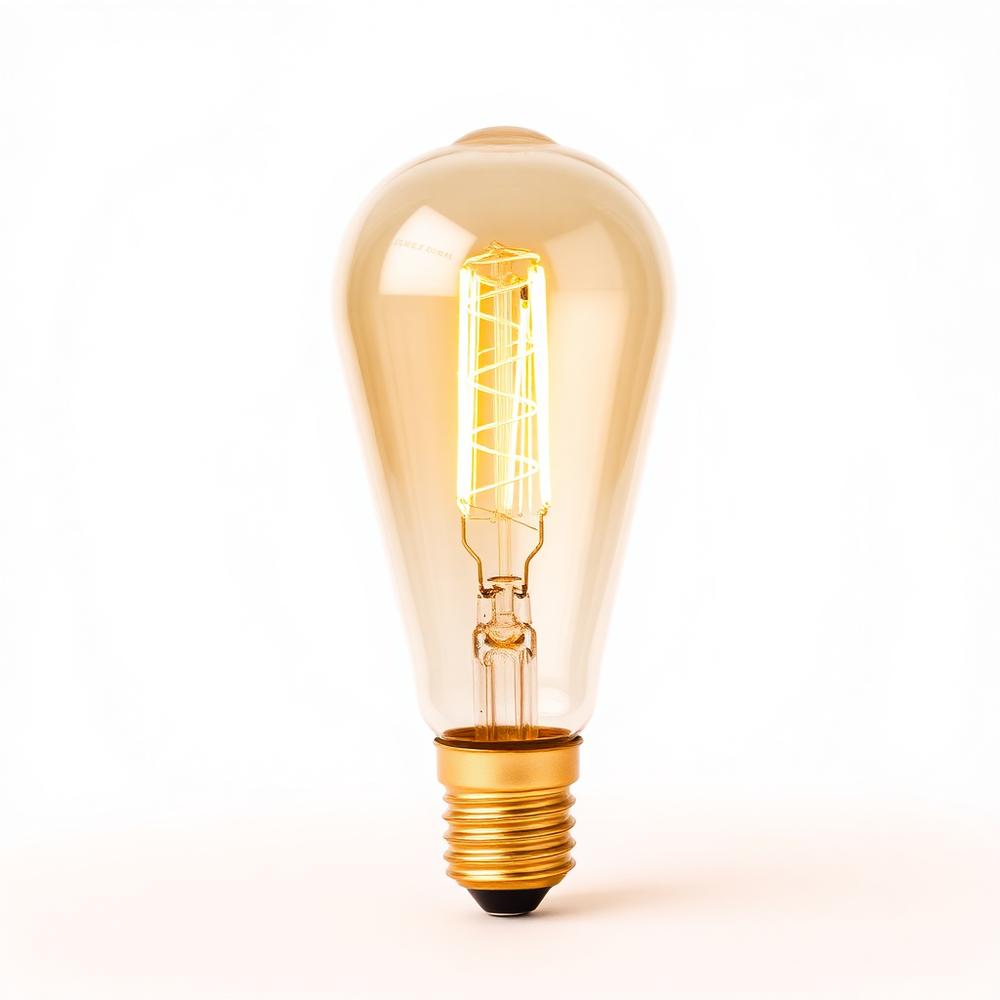
The final chapter is aesthetic. The LED filament bulb — a slim rod of sapphire substrate coated in phosphor, arranged to visually mimic the original tungsten wire — proves that the warm honey glow of Edison's laboratory still commands emotional loyalty a hundred and forty-five years after its invention.